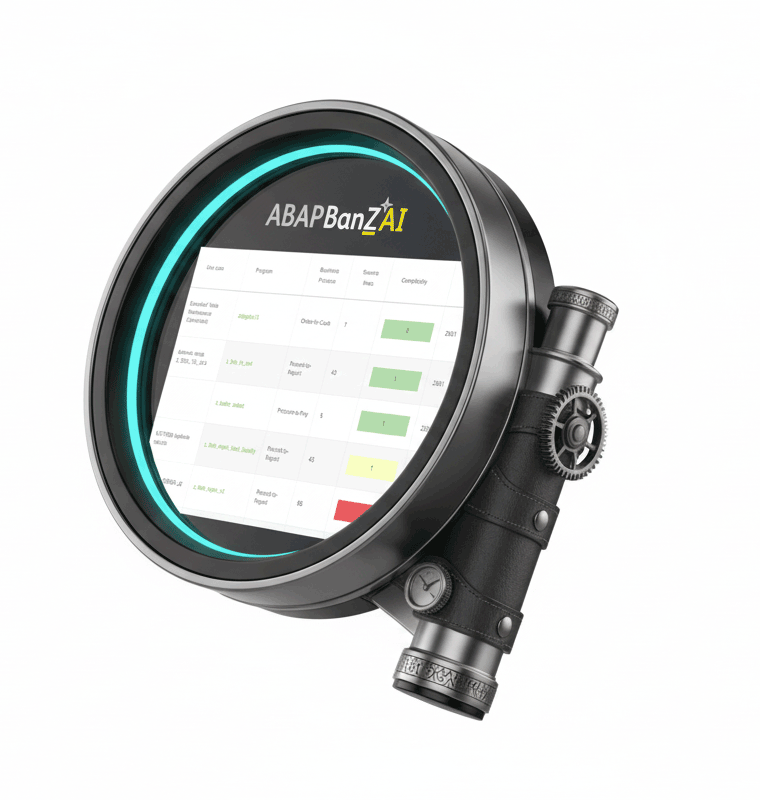


Your custom ABAP code is the biggest obstacle to your S/4HANA migration. Now you can see all of it.
Most organisations have thousands of Z objects built by developers who've long since left. ABAPBanZAI uses AI to give you the complete picture of your custom ECC code in days.

Your custom ABAP code is blocking your path to S/4HANA.
You can't migrate what you can't see. When it's time to move to S/4HANA, this is your biggest obstacle
Thousands of Z objects - Reports, Interfaces, User Exits, Enhancements and Batch jobs - Built by developers who've long since left. Solving problems nobody fully remembers, for processes that may have changed beyond recognition.
With the 2027 ECC deadline approaching, this isn't a technical inconvenience. It's your biggest S/4HANA obstacle.
ABAPBanZAI connects directly to your SAP system and does what no team of consultants can — analyses, classifies, and documents your entire custom code estate in days, not months.
For the first time ever, you'll know exactly what you have in your SAP ECC system. What it does. And what to do with it.

AI Powered Custom Code analysis for SAP
ABAPBanZAI connects directly to your SAP system and applies AI to analyse, classify, and document your Z code in days.
What would take a team of consultants years to produce accurately, ABAPBanZAI delivers in a fraction of the time — with greater consistency, depth, and confidence.
Classify your SAP Z Code using AI
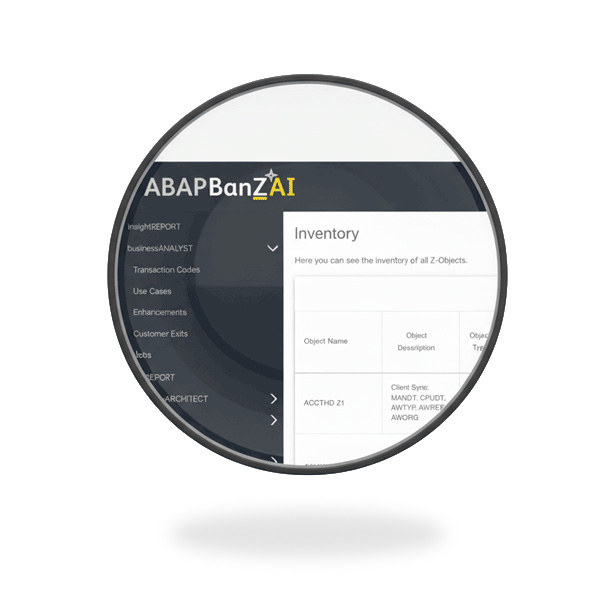
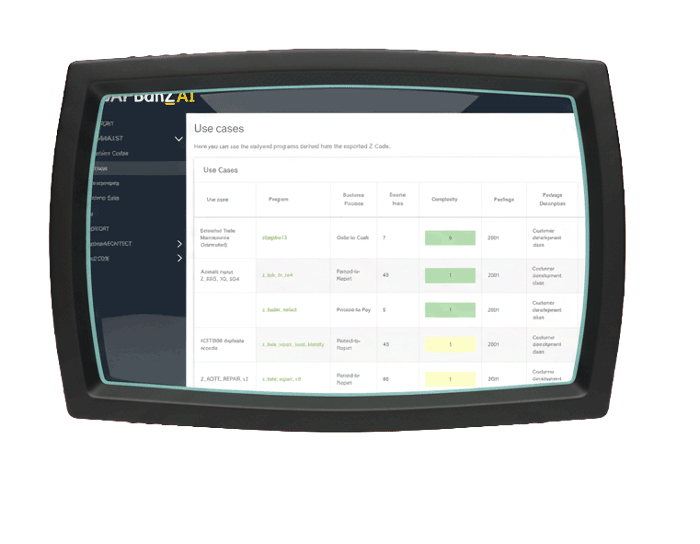
ABAPBanZAI analyzes and classifies every custom object in your SAP landscape
— automatically, at scale.
- Reports — a complete list of all custom reports in SAP
- Interfaces — identification of all SAP integration points
- User Exits & BADIs — what standard SAP behaviour they override and why
- Enhancements — where and how standard SAP has been extended
- Batch Jobs — which custom programs run as part of your overnight batch
The result: a complete, structured inventory of your custom ABAP code — not as a static spreadsheet, but as a living, searchable, AI-enriched catalogue.
Map SAP Custom Code to Business Processes
This is where ABAPBanZAI moves beyond code analysis into business intelligence.
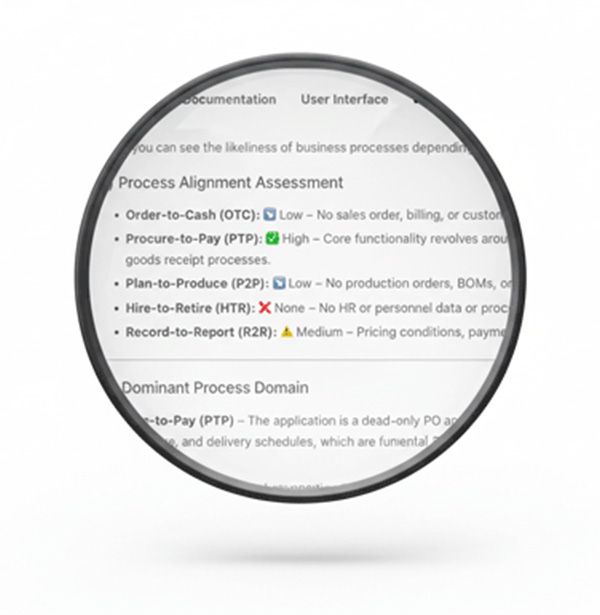
For every Z object, ABAPBanZAI identifies:
- Primary process area — the core business process this code serves
- Impacted process areas — adjacent processes touched by this code
- Irrelevant process areas — where this code has no material impact
That means your Programme Director can answer, for the first time with confidence: "Which of our S/4HANA business processes are most exposed by custom code complexity?"
And your process owners can answer: "Is this Z report actually supporting our Procure-to-Pay process — or has it been redundant for three years?"
SAP Functional Specification Reverse Engineering
Lost the original functional spec? Or, was it never written?
ABAPBanZAI reconstructs it.
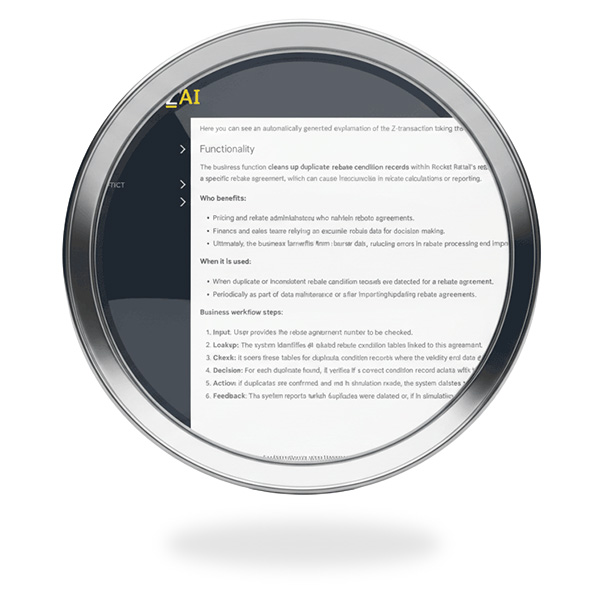
By analysing source code behaviour, data flows, and UI interactions, ABAPBanZAI generates a functional specification for each Z object — giving your business analysts, architects, and programme team a concrete foundation for fit-gap assessment, without relying on memory or guesswork.
This single capability can save weeks of discovery effort on a large S/4HANA programme.
AI Powered SAP Clean Core Analysis
ABAPBanZAI integrates directly with S4SensAI, Resulting's AI-powered fit-to-standard engine.
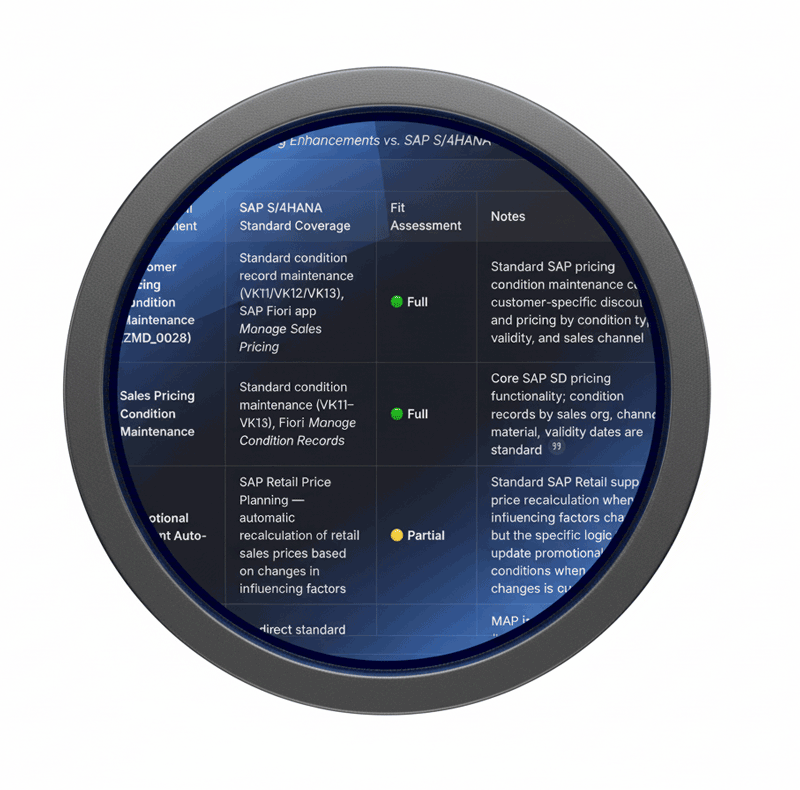
Once your Z code is automatically documented and classified, ABAPBanZAI feeds those descriptions into S4SensAI — which checks whether standard SAP S/4HANA functionality already covers the same business need.
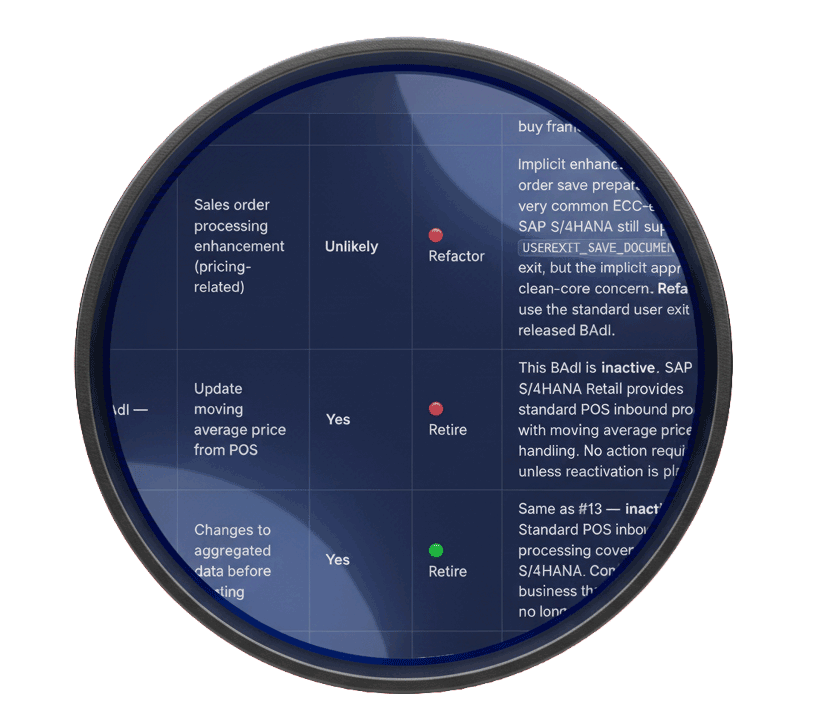
The result: an AI-assisted clean core assessment that identifies, object by object, whether your customisation is:
- ✅ Redundant — standard S/4HANA covers it; retire the Z code
- ⚠️ Replaceable — standard S/4HANA covers it with configuration; plan the transition
- 🔴 Genuinely required — the business need is real and unique; retain and re-evaluate
This fit-to-standard analysis at a scale and speed wasn't possible before AI.
SAP Technical Debt Quantification
ABAPBanZAI overlays usage frequency data across your classified code estate — so you can see not just what your Z code does, but how often it's actually used.
The combination of classification, business process mapping, and usage data gives you a complete technical debt picture:
- Code that is complex, business-critical, and heavily used → Retain and invest
- Code that is complex, business-critical, and never used → Investigate and decide
- Code that is simple, peripheral, and unused → Retire with confidence
For the first time, technical debt stops being a vague concern and becomes a structured, prioritised, defensible asset register — one you can take to your CFO, your board, and your SI partner with confidence.
Your SAP Code Neatly Documented
The output of ABAPBanZAI isn't a static list or spreadsheet. Your team gets access to an interactive interactive, searchable Wiki documenting every custom SAP object.
This includes full code description in the form of a reverse engineered functional spec, logic flow diagrams, UI mock ups, table hits and even complexity analysis.
The Wiki output integrates with S4SensAI to enable AI interaction with documentation to enable automatic fit-to-standard analysis and even AI reconstruction of clean-core BTP code against the AI generated documentation.
S4SensAI - The SAP Architect
The World's most SAP-experienced SAP Architect working right inside your SAP team
- Deep SAP ERP knowledge in every version from ECC to S/4HANA 2023, including RISE and GROW
- Exceptional functional SAP expertise in every module and industry solution
- Expertise in the full Business Suite of solutions - SuccessFactors, Ariba and Fieldglass
- Unparalleled SAP technical knowledge including integration architecture
- Able to produce detailed functional and technical specifications in minutes
- Expert in solution definition for complex SAP business scenarios
- Can perform fit-to-standard analysis and make Clean Core recommendations
- Writes detailed configuration guides and user storyboards for S/4HANA functionality
- Put S4SenSAI to the test - ask any SAP question and we'll blow your mind

Puma - SAP Programme Manager
Meet the most experienced SAP Programme Manager you've never worked with.
- Builds detailed project plans in the time it takes to make a coffee
- Converts plans to be imported into MS Project or Jira
- Creates comprehensive risk registers based on real-world challenges
- Produces rapid estimates for SAP projects and enhancements
- Quickly and comprehensively reviews and critiques SI plans
- Creates accurate RACI matrix models to clarify remits and responsibilities
- Generates Project artefacts that your programme needs in minutes, based on proven structures, not hand-cranked documents

Basho - SAP Business Case Analyst
The McKinsey-esque business case guru as part of your team.
- Converts SAP functionality to tangible business value
- Quantifies benefits based on real-world business KPIs
- Performs benchmarking to give realistic business benefits
- Models scenarios and tests benefits case thinking
- Creates compelling narratives that shift technical change to meaningful narrative that business people understand
- Builds compelling business case narratives that get technology investment funded.

Dogan - SAP Development Lead
An expert SAP Development lead who can shape-shift from exceptional communicator to master coder.
- Writes detailed technical specifications for SAP enhancements
- Creates first-draft code in minutes to be checked and used in your SAP environment
- Writes ABAP code and converts legacy ABAP to modern ABAP coding standards (e.g. SAP RAP - RESTful ABAP Programming Model
- Writes for BTP, including Steampunk ABAP and the SAP Cloud Application Programming Model (e.g. Java and Node.js)
- Deep knowledge of Java (BTP), JavaScript (Fiori) and SQL (HANA)
- Understands SAP best practice coding methods
- Turns requirements into technical reality without waiting for your SI's Dev team

ABAPBanZAI - AI Code Analyzer
The optional AI agent that can connect to your SAP ECC system.
ABAPBanzAI extracts your custom ABAP code from ECC or S/4HANA then uses AI to reverse-engineer functional specifications so that S4SensAI can automatically identify fit-to-standard opportunities, or propose clean-core solutions.
- Fully documents your SAP Custom Code (Z Transactions)
- Creates an interactive WIKI of your SAP Custom Code, including table hits, visual code documentation, and rich English descriptions of code logic
- Forensically recreates RICEF documentation from your ABAP code base
- Classifies custom code into Reports. Data Loads, Enhancements, User Exists, Interfaces, Batch Jobs
- Automatically identifies which business processes custom code relates to (e.g. OTC or SAP-SD)
- Ranks code complexity so that you can prioritise clean-core initiatives.


- Simple and secure code extract from your DEV system
- Offline AI analysis via CodeVault
- Autogeneration of secure Wiki
- Overlay of usage via SCMON extract from PRD as an option
ABAPBanZAI is an AI-powered tool that analyses your entire SAP custom Z code estate — automatically classifying every object, mapping it to the business processes it supports, generating plain-English documentation, and overlaying usage data to produce a complete technical debt picture.
It gives programme teams, architects, and business leaders the clarity they need to make confident, evidence-based decisions before and during an S/4HANA migration.
For most SAP landscapes, ABAPBanZAI delivers an initial analysis within days — not weeks or months. What traditionally requires a team of senior ABAP consultants several months to produce, ABAPBanZAI delivers at scale and with consistent depth in a fraction of the time. The exact timeline depends on the size and complexity of your Z code estate — we'll give you a realistic estimate before we start.
No. ABAPBanZAI connects to your SAP landscape via read-only access. It makes no changes to your system, your data, or your configuration. Your live operations are completely unaffected. Full technical and security documentation is available on request.
ATC is a code quality and compliance tool — it tells you whether your Z code meets technical standards. ABAPBanZAI goes much further. It tells you what the code actually does, which business processes it supports, how often it's used, and whether standard S/4HANA functionality already covers the same need. ATC is a starting point. ABAPBanZAI is the complete picture.
ABAPBanZAI is part of the Resulting AI platform — a connected suite of AI-powered tools designed to support intelligent SAP transformation. It integrates directly with S4SensAI, Resulting's fit-to-standard engine, which uses ABAPBanZAI's generated documentation to assess whether standard S/4HANA features can replace existing Z code. Together, they provide an end-to-end picture of your custom code estate — from initial discovery through to clean core assessment and migration readiness.
SAP clean core is the principle of minimising modifications and custom code in your SAP landscape — keeping the core as close to standard as possible to reduce upgrade costs, improve maintainability, and unlock the full value of S/4HANA and BTP. ABAPBanZAI identifies, object by object, whether your existing Z code is redundant (standard S/4HANA already covers it), replaceable (achievable through configuration), or genuinely required (a real, unique business need).
The result is a prioritised, defensible rationalisation roadmap — not a gut-feel estimate.
No — that's exactly the problem ABAPBanZAI solves. It generates documentation directly from source code analysis. It doesn't rely on existing specs, developer knowledge, or institutional memory. If your original developers have left, your documentation was never written, or your landscape has evolved beyond recognition, ABAPBanZAI reconstructs the functional picture from the code itself.
For each Z object, ABAPBanZAI's AI analyses the code's behaviour, data flows, transactions, and outputs — and maps them against standard SAP process frameworks including Order-to-Cash, Procure-to-Pay, Record-to-Report, Plan-to-Produce, and Hire-to-Retire. Each object is scored for its alignment to primary, impacted, and irrelevant process areas — giving business and technical teams a shared, process-led view of the custom code estate for the first time.
Yes — directly and materially. One of the biggest obstacles to a credible S/4HANA business case is the inability to quantify custom code complexity and migration effort. ABAPBanZAI turns that unknown into a structured, evidenced, prioritised asset register. You can show your CFO and board exactly how much of your estate is redundant, how much needs re-engineering, and where the real migration effort sits — before a single project plan is committed.
A manual code review is constrained by time, cost, and human consistency. Consultants can review a limited number of objects per week, each interpreted slightly differently depending on the individual. ABAPBanZAI analyses thousands of objects simultaneously, applies consistent AI-driven logic to every object, and produces documentation in a standardised, searchable, interactive format. It is not a replacement for human SAP expertise — but it dramatically accelerates and scales what that expertise can achieve.